



New
You Don’t Beat the Market, You Beat Yourself
This is for the trader who just took a loss and is already reaching to double the size and jump back in to win it back — I used to be that trader. It’s a piece about trading psychology, about the revenge-trading trap I paid tuition to understand, and about the real enemy sitting right there in your chair.
11 p.m., a red screen, and a finger that won’t leave the Buy button
11 p.m. The house is asleep. It’s just me, a glass of water gone cold, and a screen smeared one shade of red. The trade just hit its stop loss. The negative number sits there, shameless, smiling up at me.
The scary part isn’t the red number. The scary part is that my finger won’t leave the Buy button.
A voice in my head whispers — “Go back in. Double the size. One more trade and you’re even.” That’s the seed of revenge trading: opening a position right after a loss, not because the market gave you a signal, but because the bitter version of you refuses to lose.
Maybe right now, in another room, you’re staring at the exact same red screen, your finger hovering over the mouse too.
If so, hear me out: you’re not broken. You’re not weak. You’re just being human — and humans hurt when they lose, then want to snatch it back this instant. That reflex is as natural as pulling your hand off a hot stove.
But natural doesn’t mean right. Some instincts are built to save you out in the world and drown you in the market. The harder you thrash, the deeper you sink.
The real fight isn’t on the chart. It’s in your chest, in the second the number turns red. And here’s the question it took me years to dare to ask myself: in that exact second — who’s really holding the mouse?
Name the demon: what revenge trading actually is
So what is the thing that pulled my hand toward the Buy button at midnight? It has a name. And once you name it correctly, it loses half its power.
Here’s the most stripped-down definition I earned after paying my own tuition: revenge trading is when, right after a loss, you charge into the next trade to win it back at any cost. Not because the chart called you in. Not because your plan told you to. Because you’re stung. Because your ego just got slapped, and it wants to hit back. Right now.
How do you tell whether you’re taking revenge or actually trading? Hold yourself up to three signs:
- You double the size to get even faster. The last trade lost one unit, so this one you ride at double, triple — for the “one shot back to shore.”
- You tear up your own plan. The plan you wrote with a cold head, you now throw away because it’s “too slow.”
- You enter for no technical reason — except one sentence in your head: “I want my money back.”
Nod to even one of the three, and let me say this plainly.
In that moment, the keyboard in front of you stops being a trading tool. It becomes a weapon. And the cruel irony is, you’re aiming it at yourself.
This isn’t a trade. It’s a revenge. And you can’t discipline an enemy you don’t even dare to name.
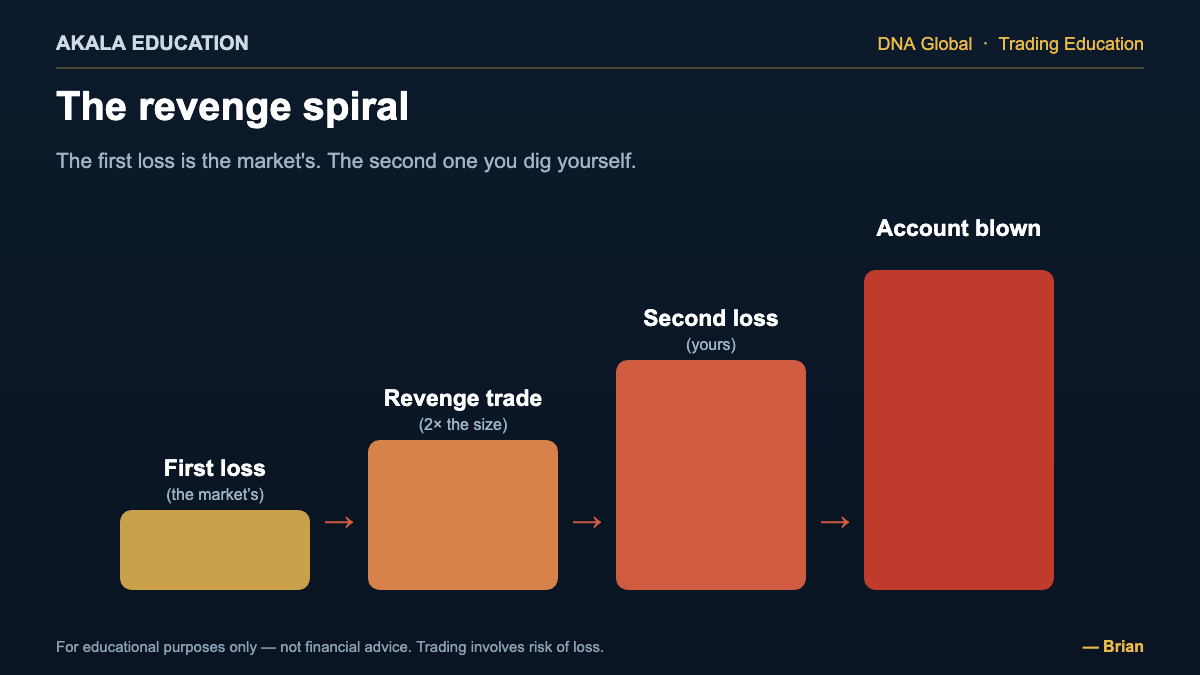
The first loss belongs to the market — the second one I dug with my own hands
I want to be honest with you, because staying quiet is easier.
It took me years to look this straight in the eye: the first loss of the day — that first trade hitting its stop — usually isn’t what kills my account. It was in the plan. It’s a risk I agreed to pay before I clicked the button. The market took exactly what I let it take. Fair and square.
The second loss is the one that buries me. And that one isn’t the market’s doing. That one I dug with my own hands. Chest tight, a voice hissing “get back in, win it back while it’s hot.” I doubled the size. I tore up the plan I’d written while my head was clear. I entered for no technical reason — only because I couldn’t swallow having just lost.
I used to call those nights “fighting.” Telling myself I was grinding, staying tough, not giving up. The truth: that wasn’t fighting. That was digging a hole and jumping in. Every “win-it-back” trade was one more swing of the shovel, deeper into the ground I was standing on. The most expensive thing wasn’t the money. I paid with the part of me that refused to lose.
And here’s what I want you to carve into your chest: on the first loss, the market takes a little of your money. On the second loss — the one you enter for revenge — you hand over what’s left of your calm. And calm is the most expensive asset you’re holding.
Because once calm is gone, every trade after that is just emotion holding the mouse.
Three fears are holding the mouse for you
Look closely at the moment your hand is itching to double the size. The thing you call “determination to win it back” — it isn’t determination. It’s fear wearing a brave man’s coat. And three fears take turns holding the mouse for you.
The first fear: fear of losing money. It whispers “I have to get back to shore tonight.” But that very urge turns a temporary loss — one fully inside the plan — into a permanent wound.
The second fear: fear that you don’t have what it takes. “Losing means I’m bad” — so you have to win right now to prove the opposite. At this point you’re not trading to make money anymore. You’re trading to rescue your ego.
The third fear: fear that it’s too late. “If I don’t recover today, the whole month is ruined.” So you sprint — like the runner who’s fallen behind, panics, and bolts off to avenge the lost kilometer, only to collapse before the finish line.
Now let me flip something over for you. The market is indifferent. It doesn’t know you just lost. It isn’t lying in wait for your particular stop loss. It’s just numbers drifting across a screen, unbothered. What carries the bitterness into the next trade isn’t the market. It’s those three fears.
The enemy doesn’t wear the market’s coat. It wears yours.
So the entry point was never the real problem. Protect capital first, profit second — and to protect capital, you have to protect a cool head first.
You don’t lose because you lack the talent. You lose because you let fear hold the mouse for you. And you don’t beat the market — you beat the impatient version of yourself, or it beats you. There’s no third box.
The smartest move after a loss: stand up from the desk
I used to believe a good trader is someone who always knows which button to press next. Wrong. The hardest thing I ever learned wasn’t entering a trade — it was not entering one.
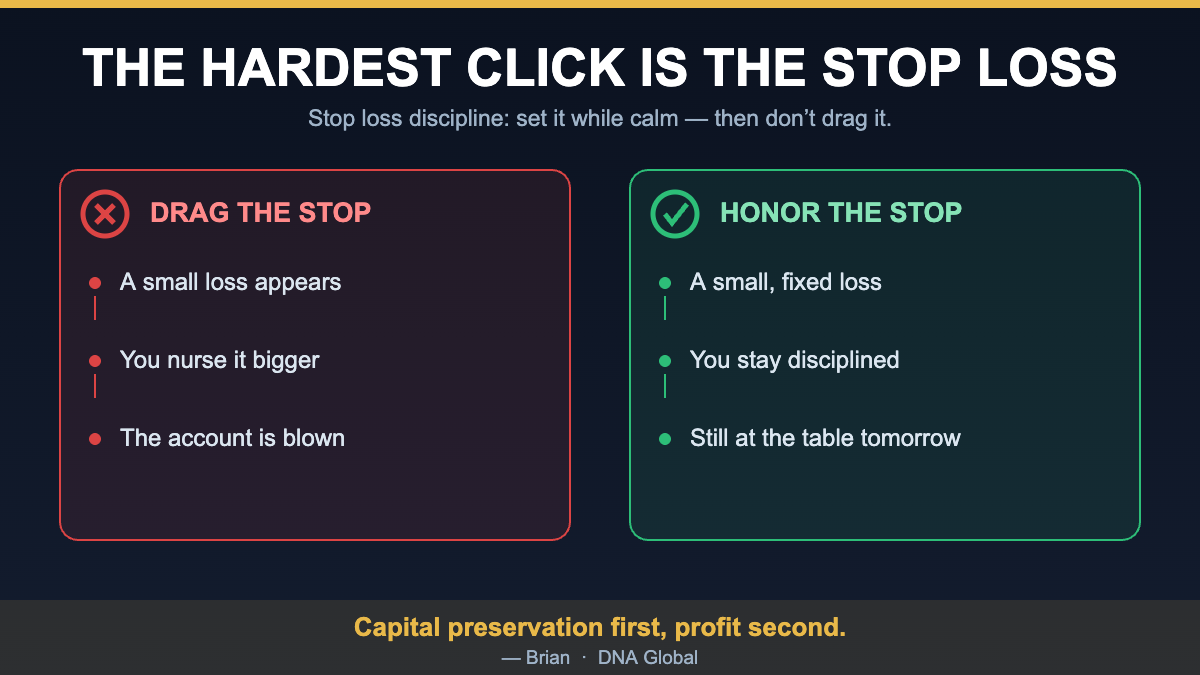
This isn’t a rule I’m forcing on you. It’s just my own way, bought with nights of digging holes and filling them back in. If there’s one piece I lean on most, it’s the same one I wrote about in The Hardest Click Is the Stop Loss — the click that protects you costs the most.
Step one, I name it. Out loud, if I have to: “You want to win it back.” That’s all. What has a name, you can hold. What stays nameless is what holds you.
Then I leave. Turn off the screen. Stand up. Drink a glass of water. Walk a few laps until the adrenaline drains. While the body is still boiling, the head can’t go cold.
I learned this from the running track. When the pace slips, the amateur sprints to take revenge and collapses mid-race. The long-distance runner does the opposite: hold the rhythm, take a sip of water, let the heart find its own beat — then think about chasing. It’s the same underwater. The more you thrash, the more you sink. Loosen up, hold your form, surface for one full breath — then swim on.
Only when my head is cold do I touch the mouse again — and only when there’s a technical reason, not an emotional one. React, don’t predict. Discipline here isn’t entering trades better. It’s giving yourself permission not to enter.
After a loss, the most valuable button on the screen isn’t Buy or Sell. It’s the off switch. Standing up from the desk isn’t quitting — it’s the first move of someone taking ownership. And it’s small enough that you can do it tonight.
From the bitter gambler to the owner of yourself
I want to step back. Because this is bigger than the Buy button at midnight. Bigger than me.
When you enter a trade to win it back, listen to the language in your head. “The market just took my money.” “The house hunted my exact stop.” Hear the common thread? In every one of those sentences, you’re the victim. And a victim always feels entitled to claim back what’s owed — so you press the button again, and again.
But there’s a truth I paid dearly to look at straight: from start to finish, only one hand touched the mouse. Mine. Not the market’s. Not the house’s. Not bad luck’s. The day I admitted that — not to beat myself up, but to take back control — was the day everything started to change.
The victim trader asks: “How do I get my money back from the market?” The owner trader asks: “How do I stop pulling more money out of my own pocket?”
That’s the whole journey I want to walk you through: from victim to owner. Not the search for some magic entry point. An entry point can’t save anyone fighting themselves at 11 p.m.
And here’s where I’ll say it plainly: there’s no one-night recovery that changes your life. No getting rich quick. I know, because I paid tuition to know. Anyone promising you the opposite is selling the exact illusion that once burned my account. Alone, you move fast. But with a system and people beside you, you go far. I choose to go far.
Next time your hand reaches to win it back — remember who you’re fighting
Next time the clock reads 11 p.m. again. When the number has just turned red and your finger is already on the mouse — itching to double the size and win it back — stop for one beat. Just one beat.
Then remember this: the one sitting across the line from you at midnight isn’t the market. The market doesn’t know who you are. The only one reaching to snatch the last of your calm — is the bitter version of yourself. And you have every right not to let it win.
Lifting your hand off the mouse at your weakest — that’s the most beautiful trade of the day. No one pays you for it. But it saves your account.
At DNA Global there’s a place to sit down — among people who once stood exactly where you’re standing tonight. No one sells you a miracle or a magic entry. We’re just there so you don’t have to let go of the mouse alone.
You don’t beat the market. You beat yourself. And you don’t have to beat yourself alone.
About the author
Brian — founder of DNA Global, a community that trains Forex/XAUUSD traders. He learned the hard way, paying tuition to the market over nights of trying to win losses back, then chose to build a system instead of becoming a signal-calling star. He runs marathons and swims — where he learned that holding your rhythm beats sprinting to take revenge.
FAQ
What is revenge trading?
It’s when, right after a loss, you jump into a new trade to win it back at any cost — not because of a signal, but because you’re stung. The signs: sizing up to recover faster, tearing up your plan, entering only because “I want my money back.” That’s no longer trading. It’s a fight with your own ego.
Why do I keep losing more the harder I try to win it back?
Because the second loss is usually bigger than the first — not because the market got harder, but because the recovery trade is fed by emotion, not reason. You’re not entering to trade anymore; you’re entering to prove yourself right. And the market never pays for ego.
How do I stop revenge trading after a loss?
Stand up from the desk. Name it: “I want to win it back.” Turn off the screen, drink a glass of water, walk until the adrenaline settles. Only touch the mouse again when your head has cooled — and when there’s a technical reason, not an emotional wound.
How do I keep emotional control when I trade?
It’s not about deleting emotion — you can’t. It’s about not letting it hold the mouse for you. Draw your lines while your head is still cold, so when the bitterness comes, the rules are already in place. Trading discipline and emotional control decide how long you last, more than any entry point ever will.
Forex/XAUUSD trading carries high risk and can cost you your entire capital; this content shares personal psychology and experience, not investment advice.
— Brian