


New
The Hardest Click Is the Stop Loss
Stop loss discipline isn’t something you read — it’s something your hand does at 2 a.m. I’m writing this for you, the trader who knows by heart that you should cut, but who sat staring at the stop last night and couldn’t bring yourself to press the button.
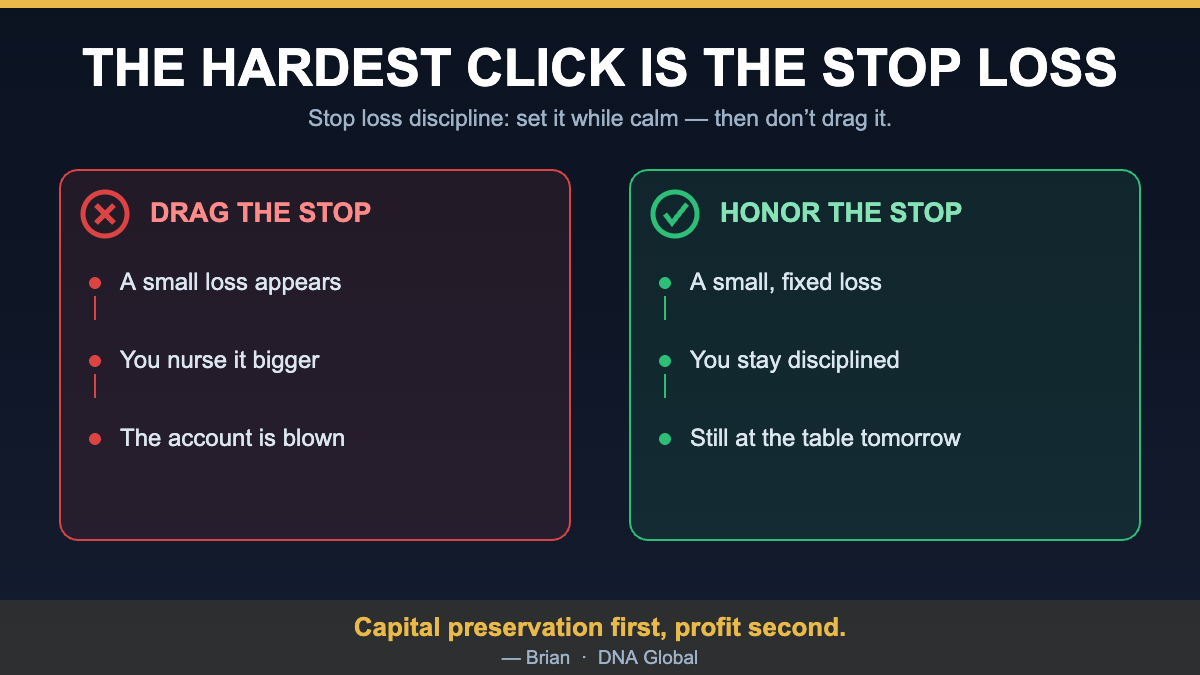
The hardest click isn’t Buy, and it isn’t Sell
Two in the morning. Dark room. Just the glow of the screen on my face — green, then red, red, then green. My cursor hovered over the Close button. My finger rested there, ready. Frozen. I knew I had to press it. For a whole hour I’d been telling myself to press it. My hand wouldn’t listen.
Then it did something else. It slid the cursor over to the stop loss — the level I’d set earlier, when my head was still clear — and dragged it a few dozen pips farther out. Just a little more. That familiar voice. Give it one more chance. The price is about to turn around.
You know that moment. I know you know it.
Stop loss discipline doesn’t die on the chart. It dies in those few seconds of a hesitating finger. Heart pounding like you’re at the final kilometer of a race. Your whole body tense over a decision that should have taken half a second.
And here’s what it cost me years to understand: the hardest click in trading isn’t Buy. It isn’t Sell either. It’s the click that admits you were wrong. Opening a trade is easy. Setting a stop is easy. What’s hard is not touching it when the blood rushes to your head — pressing Close while it still hurts.
So the question I want to ask you — the same one I asked myself in that dark room — is this: why do we know full well we should cut, yet our hands do the exact opposite?
The night I let a scratch eat my whole account
Let me tell you about the night that question carved itself into me the deepest.
That trade, at the start, was barely down. A scratch. So small I told myself: just wait a little longer, it’ll turn around.
I’d set my stop — properly, while my head was still clear. But as the price crept toward it, that voice rose up again, whispering so sweetly: Drag it out a little farther. Give it one more chance. Cutting now means losing real money.
And I listened. I dragged the stop farther out. Then dragged it again.
What I feared that night wasn’t being wrong. I feared pressing Close and watching a negative number become real. I was so afraid of losing more that I chose to lose more. That’s how backwards it gets. But I’d bet you’ve stood exactly where I stood.
The price didn’t turn around. It never promised it would.
The scratch I refused to treat kept spreading until it had eaten most of the account. And what it took wasn’t only money. It took the nights after — the ones I sat before a dark screen, watching my faith in myself slide down with the price line.
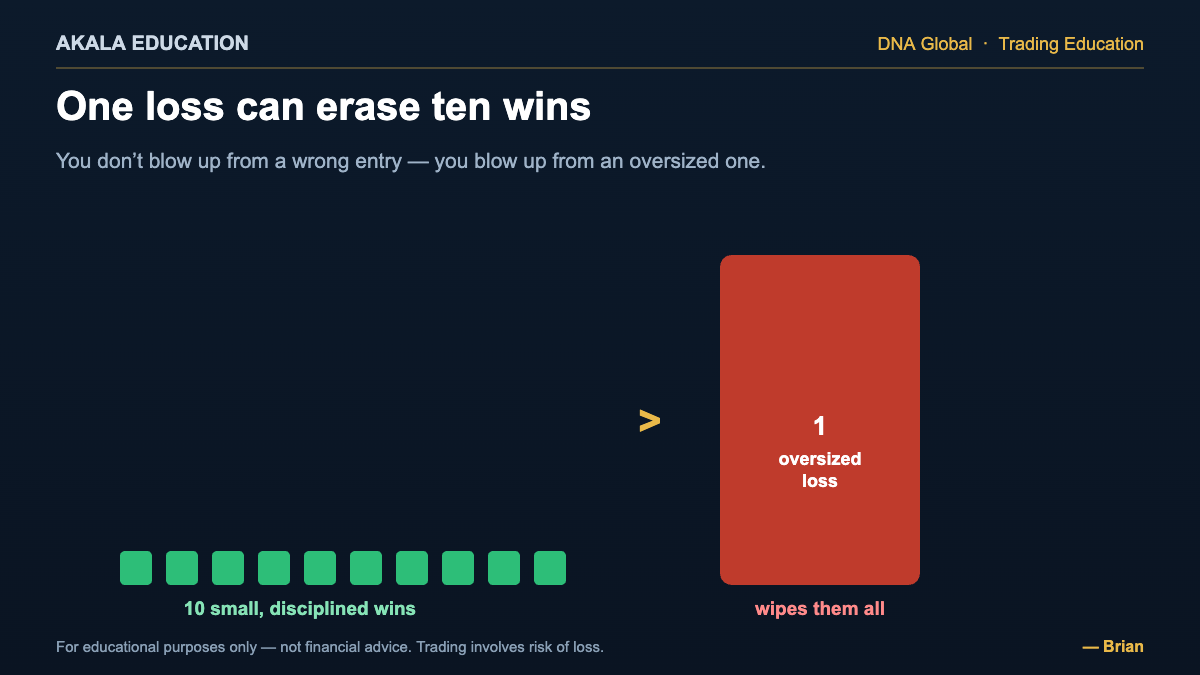
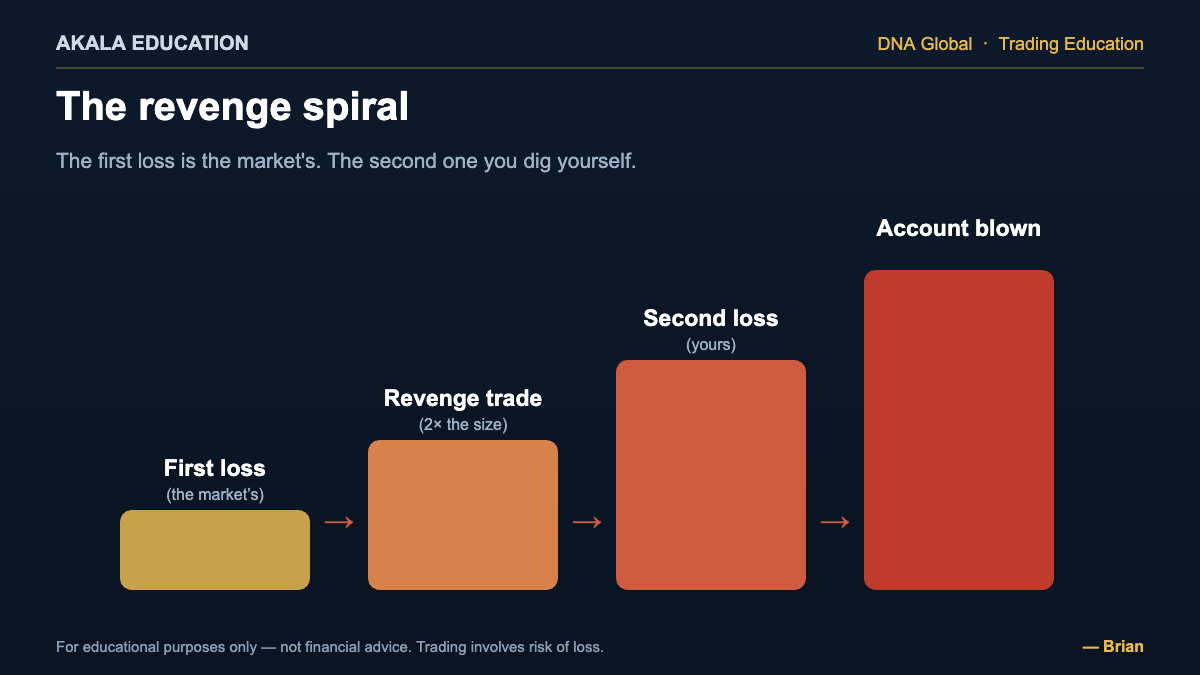
I learned this by paying tuition, not by reading a book: an account rarely dies from one wrong call. It dies from one small wrong call nursed into a loss too big to carry.
And here’s the part that stings the most: you don’t blow up because you lack knowledge. You know perfectly well you should cut. You blow up because you know and don’t do. The gap between knowing and doing — that’s where accounts die.
When I first picked up a camera, I kept every frame, even the blown-out ones I couldn’t bear to lose. And the whole album got worse for them. Holding a losing trade is exactly that — you cling to a ruined photo and let it spoil the collection. In photography, daring to delete is a skill. In trading, daring to cut is a skill too — and a far more expensive one.
You don’t lose on the entry — you lose on what you do next
But if I stopped there, you’d think the problem is the stop. It isn’t. The problem sits one layer deeper.
There’s a truth it took me years and no small amount of money to swallow: I used to believe that if I could just find the perfect entry, my whole life would turn the page. So I hunted that holy grail. I bought indicators. I drew trendlines until my wrist ached. I read every candle as if getting one right would change the color of the whole account.
Then I swallowed the bitter pill. I was entering trades better than plenty of people. And I was still blowing up.
The problem was never where I pressed Buy. It was what I did after. A beautiful entry with no self-control is just a luxurious beginning to a disastrous ending. The market doesn’t pay the best entry-finder. It pays the one who stays at the table the longest.
And hear this closely, because I once needed someone to say it straight to my face: you don’t blow up because you’re stupid. You blow up because there are two people inside you, and you keep letting the wrong one hold the mouse.
The morning version of you calculates cold as ice, knows exactly where to get out if you’re wrong. The midnight version — price bleeding red, heart like a war drum — isn’t trading anymore. That person is begging the market to turn around. And the tragedy is this: it’s the late-night beggar who’s allowed to delete the order.
My turning point wasn’t an indicator. It was a contract. I treat the stop I set while clear-headed as the signature of the wisest person inside me — and I forbid the panicked version from tearing it up.
Because the heart of this game fits in one line: entering is a decision made by hope, and cutting is a decision made by truth. And truth is always harder to swallow than hope.
Cutting a loss isn’t admitting defeat — it’s buying a ticket to stay in tomorrow
That contract only holds when I flip how I see the words “cut loss.” And here’s the flip that saved me.
I used to believe: “Closing now means I’ve lost.” I believed that for years. And that belief nearly took my whole account.
Today I’ll say it straight, the thing I wish someone had said to me sooner: cutting a loss isn’t you losing. It’s you paying a small fee — to keep the right to play the next round.
Picture it as a ticket. Nobody walks into the arena without buying one. The stop you set is the cheapest ticket to sit at the table again tomorrow — a small, predefined amount lost so you don’t lose everything. That’s a bargain, not a defeat. Capital preservation first, profit second. While you still have capital, you stay. Run out, and you leave the table — nobody asks if you were right or wrong, you’re simply out of turns.
I swim. And underwater there’s a truth no book can teach: the more you panic, the more you tense; the more you tense, the more you sink. Holding a losing trade is exactly that — you grip tight because you think holding is safe, but the grip itself drags you down. The person who can swim isn’t the strongest. It’s the one who dares to let go at the right moment, to relax their form on the right beat, so they float up and breathe. Cutting a loss is that release. You let go of the wrong thing — so you can surface, and keep swimming.
So remember: cutting a loss is not the end. It’s the cheapest ticket to sit at the table again tomorrow.
Stop loss discipline lives in the hand: one small thing to do tonight
So is changing how you see it enough? Not yet. Because the view lives in your head, and your hand at midnight can’t read your head.
You can read ten books on cutting losses. Memorize the definition of a stop loss. Nod along to every line about risk management, even teach it fluently to someone else. Then night comes, the price goes against you, and your hand still drags the stop out. Why?
Because stop loss discipline doesn’t live in your head. It lives in your hand. And the hand only remembers what it has done, not what you’ve read.
So tonight I’m not asking you to change your whole self. I’m asking for one small thing. The next trade — not the one that blew up yesterday, the next one — you do three things right.
One, set the stop in the same action as the entry. No “enter first, figure it out later.” The stop is part of the trade, like brakes are part of the car — nobody drives onto the road and then goes to install the brakes.
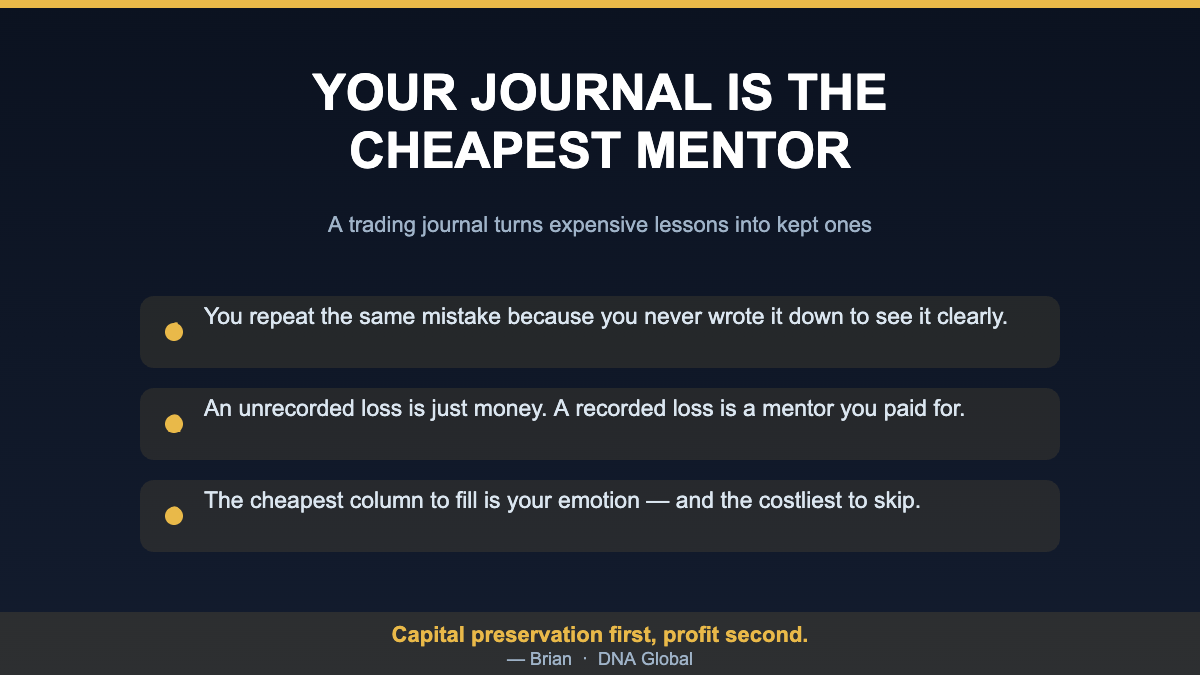
Two, write that number down. A notebook, a phone note, anywhere. A number on paper is a signed promise. A number in your head is just an intention.
Three, one single commitment: you’re allowed to tighten the stop closer, never to drag it farther out. This is the most important half-sentence in the whole piece.
And don’t torment yourself over the nights already gone. You can’t fix yesterday’s click. You can only fix the next one.
But I have to tell you a truth, plainly: at midnight, alone, your willpower will lose. Not because you’re weak — because that’s how human beings are built.
Have you ever watched a marathon? The runner who hits their goal rarely runs alone. They stick with a pacer, with a group — because at the final kilometer the body screams to stop, and reason alone can’t beat that scream. What keeps them on the road isn’t willpower. It’s the person running beside them. It’s the same discipline I wrote about in Discipline Creates Freedom — not summoned, but built, with company.
Trading is the same. You don’t beat the market. You beat the impatient version of yourself — far easier when there’s a hand to hold yours back from the stop. Alone, you go fast. With a system and people beside you, you go far. I choose to go far.
From market victim to owner of the game
And here’s the biggest thing I want you to carry — bigger than any tip about setting a stop.
I’m not writing these lines so you win a few more trades next week. I’m writing because I lived those sleepless nights — sitting in front of the screen, blaming the news, the broker, the “irrational” market, blaming everything except my own trembling hand. I don’t want you to pay the tuition I paid.
So let me say it plainly. There’s no getting rich quick. There’s no magic entry. There’s no signal that’s a sure win. I paid in money and in long nights to learn they don’t exist — and anyone who promises you the opposite is selling you a dream, not a system.
For years, I believed I was a victim. Of a stop hunt. Of one candle nobody saw coming. I lived as if the fate of my account sat in the market’s hands. Then one day I understood: the Close button is in my hands. Always. I can’t decide where the price goes — but I decide, exactly, the maximum I’m willing to lose. The cut-loss click never belonged to the market. It belongs to me.
That was the day I stopped being a victim.
The market doesn’t take your money. You hand it over yourself — every time you refuse to close a losing trade.
This is why I built DNA Global. Not to sell anyone a dream of overnight change, but because no one should sit alone in that midnight room. A community, a system, a few people walking the same road — so the day you realize you’re in charge arrives sooner than the years it took me.
FAQ
Should I drag my stop loss farther out when the price is about to hit it?
No. Almost never. The stop you set while clear-headed is the most honest version of you. The voice coaxing “just drag it a little farther” as the price closes in — that’s fear wearing the coat of reason. Tightening a stop closer to lock in is fine. But dragging it out is different: you’re not giving the trade another chance, you’re giving fear more power. A stop only has value when you don’t touch it.
Why do I know I should cut, yet still can’t do it?
Because knowledge lives in the head, and fear lives in the fingers. You’ve read enough. But when the price is glaring red in front of you, what wins isn’t what you understand — it’s what you’ve trained yourself to do. That’s why you can know ten things and still drag the stop: the hand has never practiced letting go. Trading psychology is a skill of the body, not just the mind.
Is cutting a loss the same as losing?
It isn’t losing — it’s paying a fee to keep the right to play the next round. The real loser is the one who clings to a small wrong call until it grows too big to carry. Capital preservation first, profit second.
How much should I set my stop loss at?
There’s no golden number for everyone. A sound stop sits where the trade’s structure is invalidated — where price reaching it means the reason you entered was wrong — and it has to stay within a loss you can sleep through. Set the stop by the market, not by greed.
About the author
Brian is the founder of DNA Global, a community that trains Forex/XAUUSD traders. He once believed that finding the perfect entry was the thing that would change his life, and paid tuition for that belief — in money and in long nights — before choosing to build a system rather than play the signal-calling star. Away from the trading desk, Brian runs marathons and swims, where discipline is forged the same way: one morning at a time.
Risk note: trading Forex/XAUUSD carries a high risk of capital loss. The content above shares personal experience and a way of thinking — it is for learning, not a buy/sell recommendation or a promise of profit. Consider your own risk tolerance carefully before trading.
Stop loss discipline isn’t willpower, and it isn’t a secret. The hardest click is the stop loss. It always was. And it was always yours.
— Brian