



New
AI for Traders and Financial Analysts: A Powerful Assistant, Not an Oracle
In 2026, everywhere I go I hear the same line: “AI is about to replace traders.”
I think the opposite — AI won’t replace you, but a trader who knows how to use AI will.
That sounds a little blunt. But it’s the thing I’m most convinced of after a year of using it and watching closely.
And in this article, I want to pull you out of the two traps most traders fall into.
The two traps with AI
The first trap: fear. Fear that the machine is smarter, faster, and that you’ll become redundant.
The second trap, the opposite but more dangerous: worship. Believing that if you just ask AI, out comes the perfect entry, a ready-made winning setup.
Both traps come from one misunderstanding. People think AI is an oracle. It isn’t.
AI is a very fast analytical assistant, but it doesn’t see the future any better than you do. Gold and forex are driven by capital flows, crowd psychology, and surprise news. No model can predict that for certain. Anyone selling you a bot that “knows the future” is selling you a fairy tale.
What AI does well — and what it can’t do
Let me tell you about an old morning of mine. I’d open 12 chart tabs at once. Three monitors, news everywhere, my mind overloaded before the London session even opened. I made decisions already exhausted.
It’s different now. I use AI as an assistant, and it carries exactly the work it’s good at.
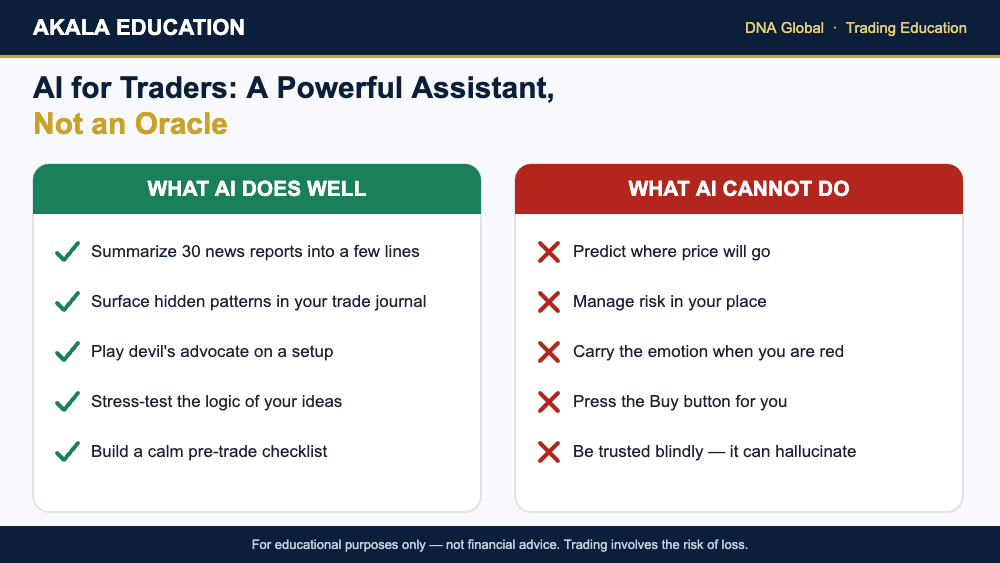
1. Compressing information
I used to spend 2 hours every morning reading news and filtering noise. Now I gather 30 reports, ask AI to summarize them into a few bullet points, and cut that time down to 20 minutes.
AI doesn’t tell me whether gold will go up or down. It just helps me see the picture faster so I can decide for myself.
2. Auditing your own trade journal
This is where I find AI strongest, and where few people use it. You feed in your last 50 trades, with the reason and the emotion behind each. AI surfaces patterns you can’t see yourself.
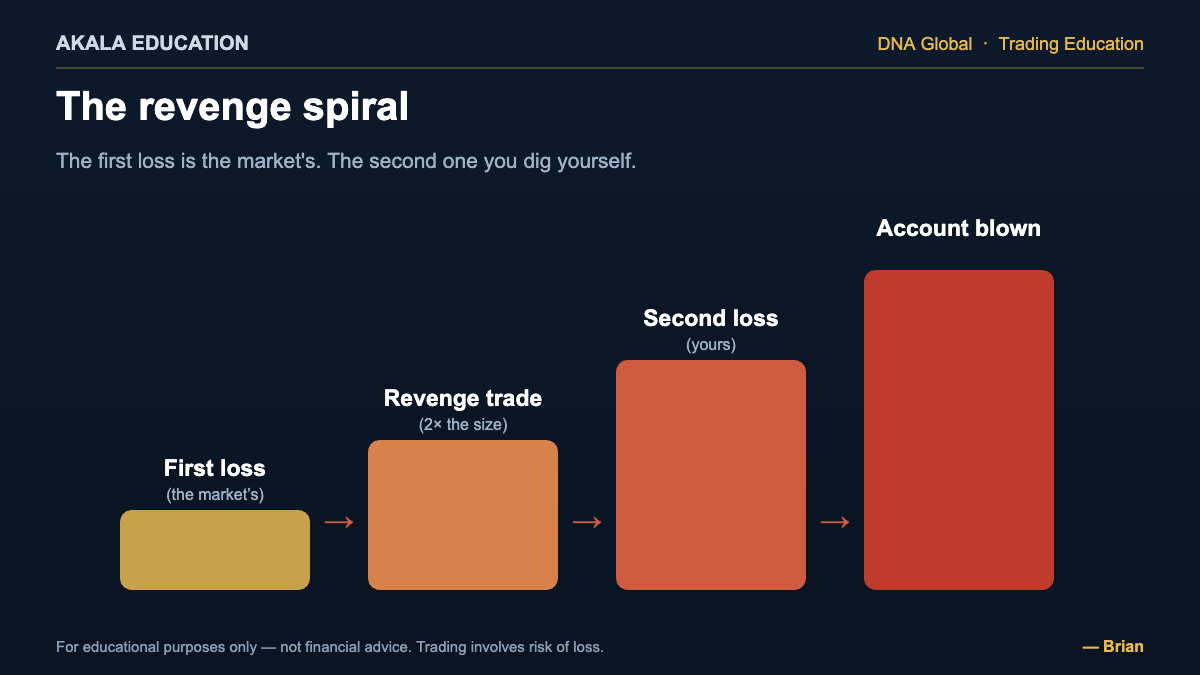
For example: “70% of your losing trades happen after 9 p.m. and right after a previous loss.” That’s the fingerprint of revenge trading, showing up in data. A cold mirror that doesn’t flatter you.
3. Playing “devil’s advocate”
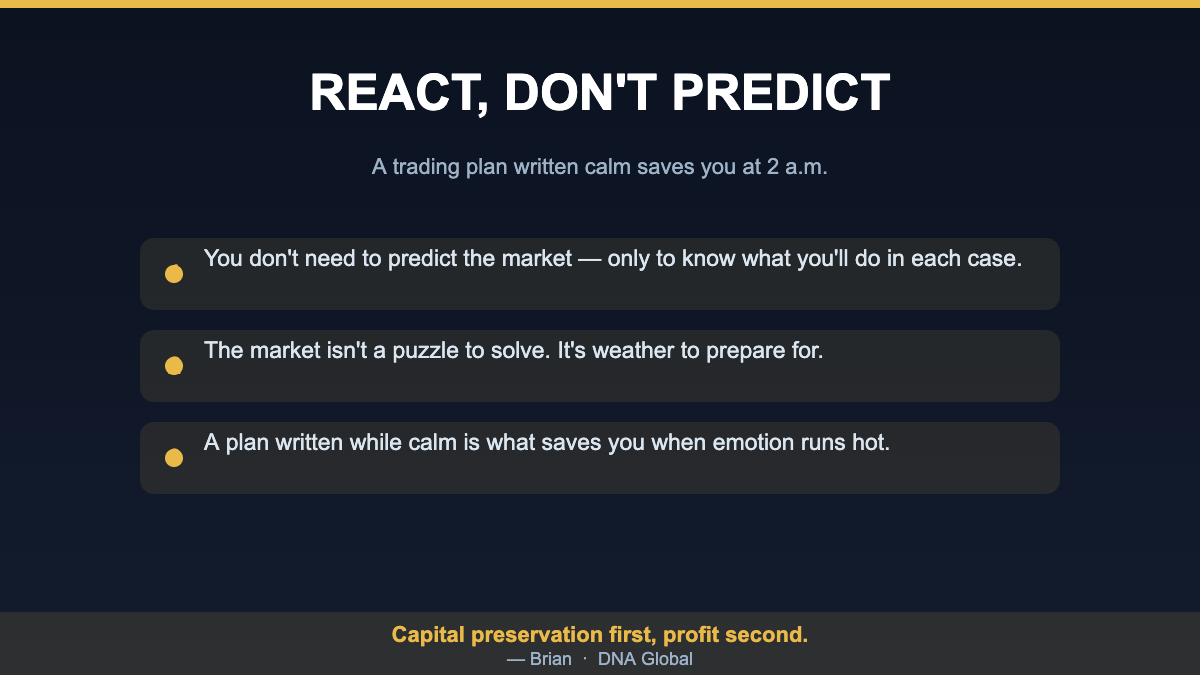
Whenever I’m too confident in a setup, I make AI argue back. “Here’s why I want to buy. Give me the 3 strongest reasons I’m wrong.” It forces me to look at both sides before I enter. True to the spirit of react, don’t predict — respond to the market, don’t try to be a prophet.
4. Stress-testing logic and ideas
Have a system idea? Ask AI to unpack the assumptions, point out the holes, and suggest how to test it on past data. It doesn’t backtest for you, but it speeds up your thinking many times over.
5. Building a pre-trade discipline checklist
I have AI build me a checklist of 5 questions. Have I defined my stop loss yet? Does this trade risk more than 1% of the account? Am I entering because of the system, or because I just lost and want it back?
After answering those 5 questions, my hot head cools a few degrees. Sometimes just pausing 30 seconds to answer them spares me a bad trade.
So what can’t AI do?
It doesn’t manage risk for you. It doesn’t carry the emotion when the account is red. It doesn’t take responsibility for the Buy button you press.
And most important: it can “make things up” with great confidence. AI sometimes produces a number that sounds real but is completely wrong.
So my rule is simple. AI proposes, the human verifies and decides. Every number it gives, I check against the source before I trust it.
Who wins over the next 5 years
I believe the game isn’t “human versus AI.” It’s “the human who uses AI” versus “the one who doesn’t.”
An analyst who uses AI can process many times more data. While still saving energy for what the machine can’t do. That’s judgment, discipline, and risk management. That’s the human part, and it’s still the most valuable part.
After time alongside fellow traders in the DNA Global community, I notice the ones who progress fastest aren’t the ones who use AI the most. They’re the ones who give the machine the right tasks, and keep the right tasks for themselves.
Start small
This week, try just one thing. Take your last 20 trades, feed them to AI, and ask: “What is my repeating mistake pattern?” Read the answer with a critical mind; don’t believe it instantly. That single exercise alone will show you how good a mirror AI can be.
If you want to learn how to use AI as a disciplined analytical assistant — the right way and within the right limits — come join us in the DNA Global community. We share applications for education only — no bots for sale, no hype.
AI isn’t the trader’s enemy. Lazy thinking is the enemy. A tool only amplifies who you already are — the disciplined become more disciplined, the careless more careless.
For educational purposes only — not financial advice. Trading always carries the risk of loss; you can lose part or all of your capital.