



New
The Perfect Entry Doesn’t Exist
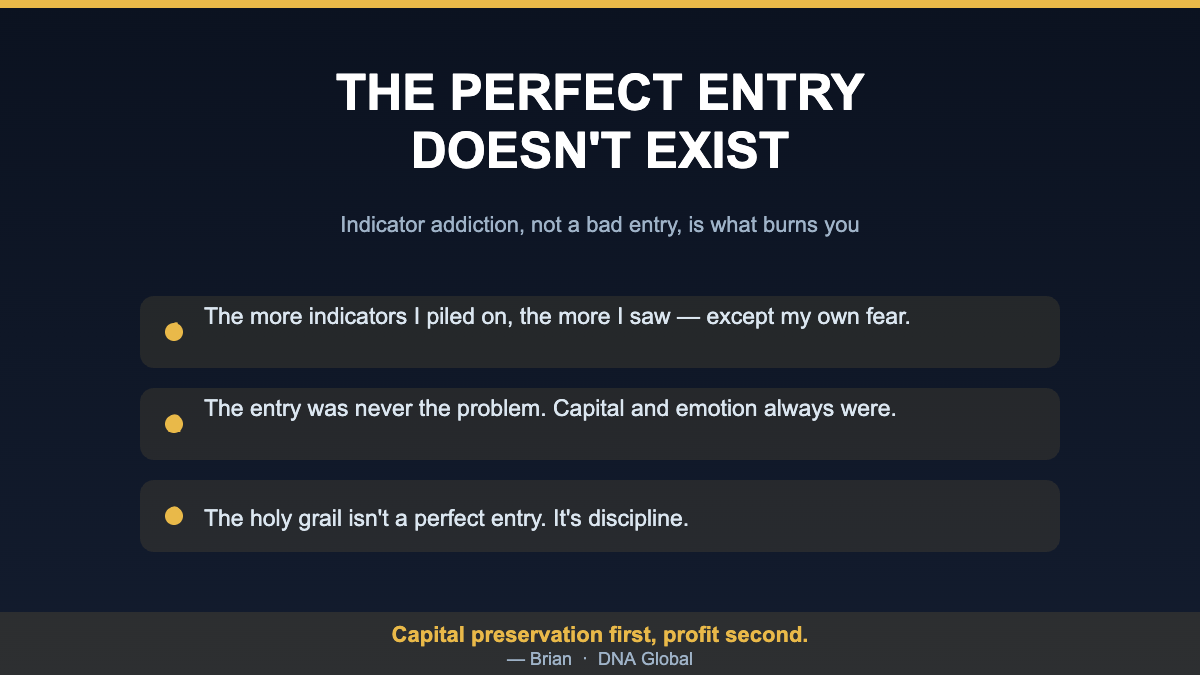
I used to believe that if I just found the right entry, my whole life would change. I paid the tuition — in blown accounts, in nights I couldn’t sleep — to learn that the perfect entry I was hunting for was never on the chart at all.
The night I had every indicator and still couldn’t click the mouse
2 a.m. The room dark, only the cold blue glow of the XAUUSD chart on my face. The screen was a maze: RSI in the lower panel, MACD just crossing, three moving averages tangled together, Bollinger bulging, Stochastic blinking, Fibonacci strung across it like a spiderweb. I had piled on everything I’d ever learned. All of it.
My finger sat on the mouse. Trembling, slightly.
I was waiting for that sacred moment when every indicator would nod at once — would say “go.” The perfect entry. The holy grail I was certain sat just out of reach, needing only one more confirmation.
Then the signal came. Clean. Beautiful. Textbook.
My hand stayed frozen.
“Wait — Stochastic hasn’t fully crossed yet.” So I waited. Five minutes. Ten. The price started to move. It moved without me. By the time I found the nerve to lift my finger, it had run half the distance. Too late to enter, too painful to let go. I watched the opportunity turn into a red number in my head.
That wasn’t a shortage of tools. That was analysis paralysis — a disease I injected into myself every single night.
I used to think the answer was more. One more indicator, one more combo, one more layer of confirmation. Like a beginner with a camera who thinks another lens is what makes a great photo. But real photographers know the opposite: a beautiful image doesn’t come from cramming gear into the frame — it comes from stripping away everything that doesn’t belong, until only the subject remains.
My chart that night had no subject. Only noise.
And the question that hit me — the one you might be whispering right now — was this: why do I own every tool on earth, and my account is still on fire?
The late realization: I was addicted to indicators, not short of them
I had to torch I-don’t-know-how-many accounts before I could finally name my own disease.
For a long stretch, every time I lost, my reflex was identical. I didn’t ask why I lost. I went hunting for what was missing. A new indicator. A combo nobody had stacked yet. A “holy grail entry” I was sure was buried somewhere, waiting for me to dig hard enough. Lose this session, download another preset. Lose the next, hear someone praise Stochastic paired with Fibonacci, pile it back onto the chart.
Like a man buying a new lens for a photo with bad composition. The mistake was where I’d placed the camera — not in the lens I didn’t own yet. But I would never look there. Looking at bad composition means looking at yourself. Buying more gear is so much easier.
Equipment can’t save the frame.
And much later, after I’d paid the full tuition, I saw it: my blowups were never about the entry. Every indicator I stacked on wasn’t a tool — it was a place to hide from the real questions waiting after each trade. How much do I lose if I’m wrong? Can I keep a cold head when price runs against me? Am I managing my capital, or just praying?
The more indicators, the louder the screen. And the louder it got, the deeper those questions sank.
So let me confess something uncomfortable. I didn’t lose for lack of an indicator. I lost because I used indicators to hide. Stacking them on isn’t the mark of a hard worker. It’s the mark of someone who’s afraid.
And I know — at least one of these three fears is yours
I’m writing these lines without thinking about myself anymore. I’m thinking about you.
Because right now — maybe also 2 a.m., maybe mid-session with a trade hanging open — one of three whispers is running in your head. At least one, I’d bet, is yours.
The first: “I’m scared of entering at the wrong spot again.” You drag the cursor back and forth, waiting for the confirming candle — because last time you entered wrong, and it hurt. But hear me: the entry is almost never the problem. Every beginner believes there’s a “perfect entry” out there, and finding it changes everything. There isn’t. What kills your account isn’t the bad entry — it’s that you’re empty-handed after you’ve been wrong.
The second: “I just don’t have what it takes.” You watch others bank steadily, look back at yourself, and pass your own sentence. Hold on. Nobody is born knowing how to sit still when their hands itch to trade, how to hold a cold head when the account is red. That’s not a gift from the heavens. It’s forged through every painful session. You’re not missing the talent — you’ve just not walked the whole road yet.
The third: “I started too late, I’ve already lost too much.” This one hurts me the most, because I said it word for word myself. But the money you’ve lost isn’t a verdict — it’s a receipt for a lesson no school teaches. The question isn’t how much you paid. It’s what you managed to read on that receipt.
Three fears, one root: you’re standing where you can’t see the real problem. You’re not broken. You’ve just never been shown where to stand.
And I remember the afternoon I found that spot — by doing the exact opposite of every instinct I had.
The day I deleted indicators and let the chart breathe
That afternoon I did the thing that runs against every instinct of a person who’s losing: instead of adding, I subtracted.
I opened the XAUUSD chart and turned off the indicators one by one. RSI — off. Stochastic — off. Two of the three moving averages — off. Bollinger Bands — off. With each one that vanished, my chest tightened a beat, like peeling off layers of armor in the cold. That blinking jungle I used to call my “weapons” turned out to be, for all those years, just a blanket I draped over something I didn’t want to look at.
The screen was uncomfortably empty. And I saw PRICE again — naked, rising and falling to its own rhythm. Strangely, what showed up clearest wasn’t the market. It was the hand itching to trade just to ease the restlessness. The head demanding I “do something” instead of sitting still. Adding indicators never cured that disease. It only helped me hide it better.
From that day, I changed the question. I stopped asking “where’s the right entry?” I asked three colder ones: if I’m wrong, how much do I lose? Is that a number I can accept? If the trade runs against me, can I hold my head? The problem was never that the chart lacked indicators. The problem was the person sitting in front of it.
That’s when I started learning to swim again. Beginners sink because they tense — thrashing, gripping hard, fighting the water. The ones who float let the body go, hold their form, and let the water carry them. Trading is the same. You only float when you let go of some weight.
I stopped trying to predict the market. I reacted to what it was actually doing — react, don’t predict. I didn’t need to be the hero who nails the exact top and bottom; I needed a system simple enough that at 2 a.m. I wouldn’t betray it.
By dropping the indicators, for the first time I stopped seeing the market. I saw myself. And the opponent I had to face was never on the screen.
The real enemy isn’t the perfect entry — it’s sitting behind your chair
I want to tell you about a trade I entered almost perfectly.
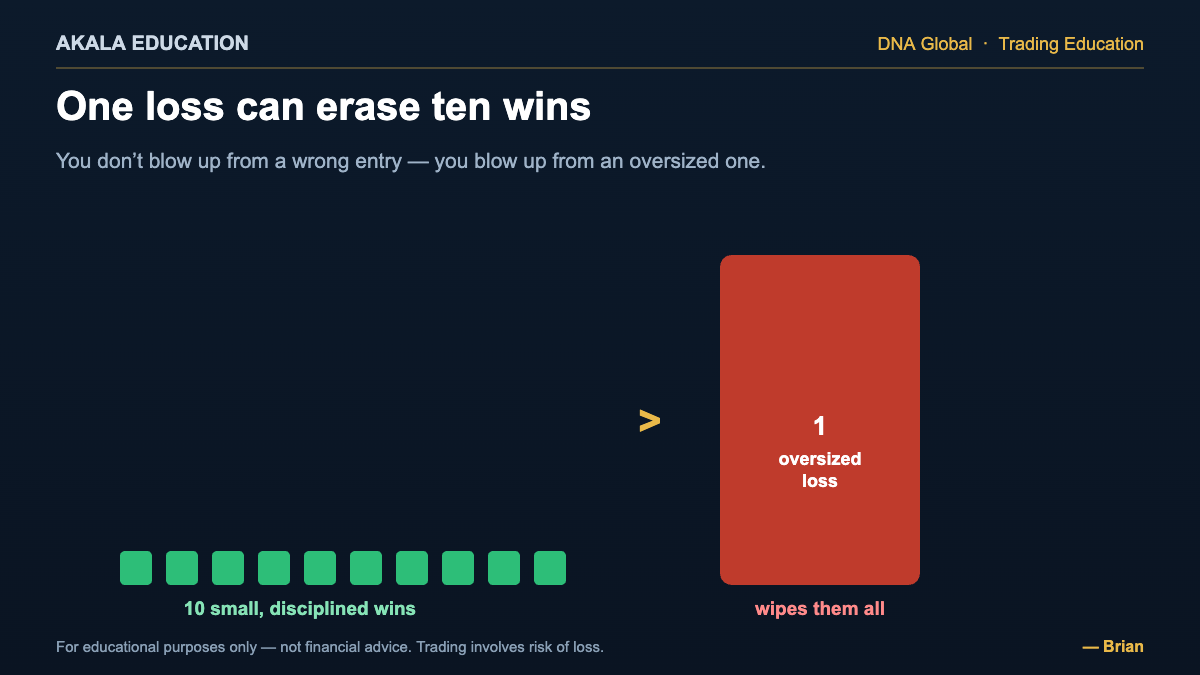
That night, everything lined up. Clear trend. Beautiful price zone. I entered with a rare confidence. Then price moved against me — just one small swing. I should have closed at the loss I’d set in advance. I didn’t. I nudged the stop down a touch — “to give it room to breathe.” Price kept going. I added more, doubled down, to “average it out nicely.” A textbook entry became one of the heaviest blowups I’ve ever had.
The entry didn’t kill me. I killed myself after the entry.
This is the brutal truth I paid tuition to learn: a beautiful entry without self-control is just a luxurious start to a bad ending.
So who’s the real enemy? It doesn’t blink on the screen. It sits behind your chair. It’s the impatient version of yourself — the one who holds a losing trade because he can’t admit he’s wrong, who moves the stop out of hope, who doubles down out of spite. You don’t beat the market. You beat that version of you.
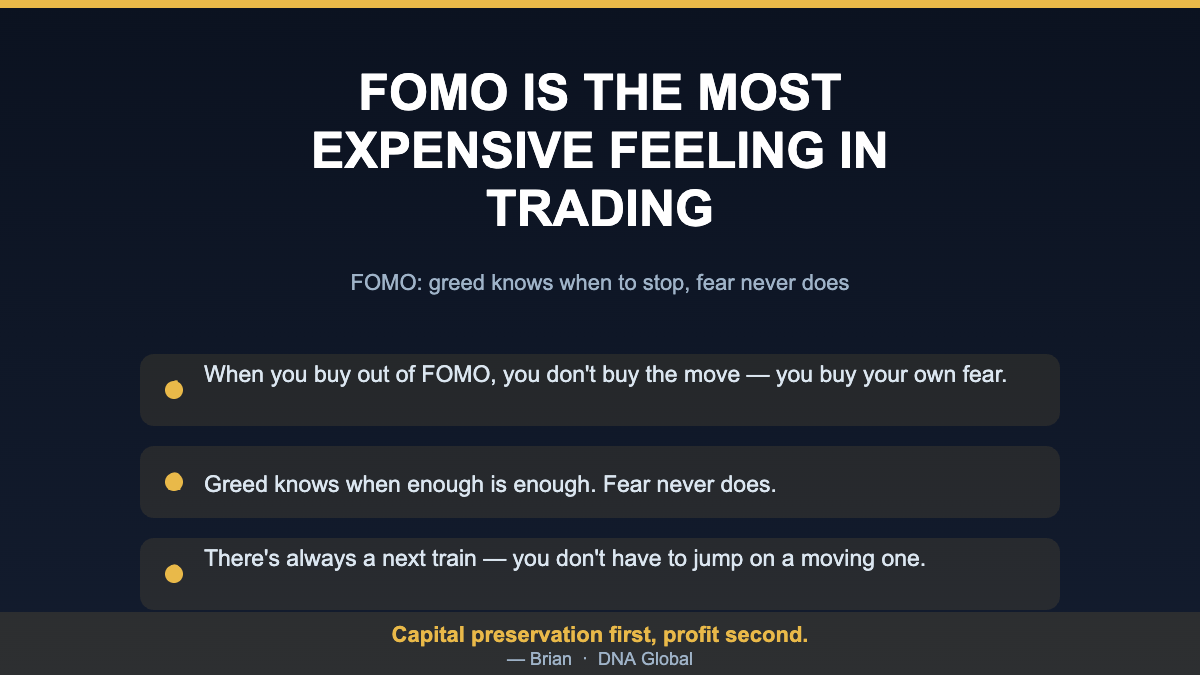
To take it down, I reversed the order of the questions. Before asking “where do I enter?”, I ask: “If I’m wrong, how much do I lose — and can I swallow that number calmly?” Preserve capital first, profit comes later. That number has to be locked before my hand touches the mouse — not haggled over mid-panic. On why that single click is so hard, I wrote The Hardest Click Is the Stop Loss.
I think about the marathon. At kilometer 30, everyone’s legs are gone; nobody finishes on their legs anymore. The one who crosses the line keeps a cold head when the body screams to stop. Trading is the same. Anyone can do the analysis. Holding yourself together at kilometer 30 of a trade bleeding red — very few can.
And that “holy grail” I hunted for all those years? It was never an indicator. It was self-control. And self-control isn’t sold in a bookstore — it’s paid for one trade, one night at a time you dare to sit still instead of act.
One small thing you can do tonight — no extra money, no course
So tonight, I’m not asking you to believe any theory of mine. I’m asking you to do three things. Small ones.
Open your chart. Look at the spiderweb of indicators smothering it. Then turn them off — until only one or two remain, the ones you genuinely understand, the ones you can explain without stammering. The rest, let them rest. The chart will feel uncomfortably bare. I know. Sit with that discomfort.
The second thing is the one that matters. Before every trade — no exceptions — write one line before you click: “If I’m wrong, how much do I lose?” Write the number down. Look it dead in the eye. Then set the stop loss before you enter, not after. The hardest click in a trader’s life is always the stop loss — the place where your ego thrashes hardest.
The third: one line of journal. One sentence, about how you felt at the click — greedy, scared, or calm.
I know you’re waiting for something grander. A secret combo. A golden hour. An indicator nobody knows. There isn’t one.
You’re not missing one more indicator — you’re missing a rule strong enough to hold you back. Discipline doesn’t begin at the next trade you win. It begins at the next trade where you dare to set your own limit — before the market sets it for you. That’s not reacting when it’s already too late. That’s building the frame in advance, then stepping in.
I don’t want you to need me — I want you to need a system
I’m not writing this so you’ll admire me. Honestly, that scares me. I’m writing it so you’ll stop blaming yourself.
The line you mutter at 2 a.m. staring at an account drowning in red — “I guess I’m just not good enough” — isn’t your fault. It was grown on purpose. A whole industry lives off it. They sell you the holy grail. The indicator set that “wins nine out of ten.” A signal every morning so you never have to grow up. They need you to feel inadequate. Because a person who feels inadequate is a person who’s easy to bill.
I paid the tuition to learn those things aren’t real. And I won’t sell you the illusion I once bought myself.
Remember the photographer from the start? The one who thought one more lens would make the picture better. A beautiful photo doesn’t come from adding gear. It comes from removing everything that doesn’t belong, until the subject appears. Trading is the same. You don’t get better by stacking on indicators. You get better when you dare to subtract — so your discipline can show.
That’s why I don’t want you to need me. I want you to need a system. Alone, you move fast. But you only go far with something to lean on, someone beside you to pull your hand back at the exact moment you’re about to break your own rule. I’ve chosen to go far. I hope you choose the same.
So here’s what I want you to carry: the perfect entry doesn’t exist — and that’s good news. You’re not blowing up because you’re bad. You’re just digging in the wrong place. The day you stop hunting the perfect entry and start building your own discipline is the day you rise out of the victim’s chair and sit down in the owner’s.
If one day you want someone to walk that road with you, I’m here. Not to feed you signals. But to forge with you the one thing nobody can sell — discipline.
About the author
Brian is the founder of DNA Global, a training community for Forex and XAUUSD traders. He once believed “the right entry changes everything,” once piled his charts full of indicators and still blew up his accounts. After paying the tuition, he drew one core lesson: the problem was never the entry, but capital and emotion management. Since then, Brian has chosen to build a SYSTEM and a team rather than play the “signal-calling star,” in the belief that discipline creates freedom. Outside the market, he runs marathons and swims — two places where he learned to hold his form and let go of the excess. Brian writes to move traders from a victim’s mindset to an owner’s, and he stands firmly against every get-rich-quick promise.
FAQ
Does the entry point matter?
Yes, but it’s not what decides whether you profit or lose over the long run. A beautiful entry without capital management and emotional self-control is just a luxurious start to a bad ending. What kills accounts usually isn’t the wrong entry, but how you handle the trade after you’re in.
How do I break indicator addiction and escape analysis paralysis?
Start by subtracting: turn off indicators one by one until only one or two remain — the ones you truly understand and can explain. A noisy screen drowns out the more important questions about capital and emotion. Simplify to see clearly, instead of adding indicators to feel reassured.
Is there a “holy grail” or an indicator set that wins for sure in trading?
No. The “holy grail entry” is a common beginner illusion, and a whole industry lives off that illusion. No indicator set replaces discipline, capital management, and self-control — things you forge session by session, not things you buy in a bookstore.
What should a beginner focus on first?
Preserve capital first, profit later. Before every trade, define and set your stop loss before you enter, know exactly how much you lose if you’re wrong, and record how you felt at the click. Discipline and risk management matter more than chasing the perfect entry.
This article shares personal experience and perspective; it is not investment advice or a recommendation. Trading Forex/XAUUSD carries high risk and you can lose your entire capital — consider carefully and only use money you can afford to lose.
— Brian